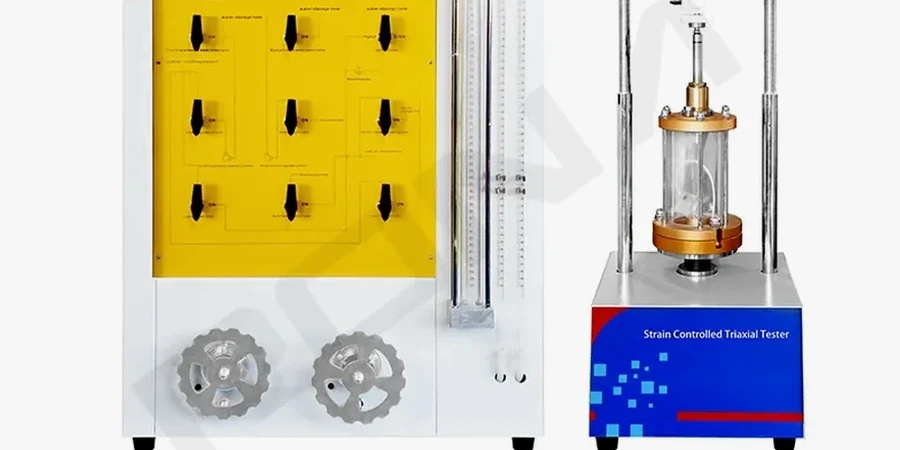
Missoula sits in a deep intermountain basin carved by Glacial Lake Missoula, leaving behind thick sequences of glaciolacustrine silts and clays interbedded with coarse alluvial deposits from the Clark Fork and Bitterroot rivers. Much of the valley floor contains soft, normally consolidated silty clays that can lose strength when saturated — a condition that demands careful shear strength evaluation. For projects requiring accurate stress-strain data and pore pressure response, our laboratory performs triaxial compression testing under ASTM D4767 and ASTM D7181 protocols. We test undisturbed Shelby tube samples from boreholes across the Missoula Valley, the Rattlesnake area, and the growing commercial corridors along Reserve Street where foundation performance hinges on reliable drained and undrained strength parameters.
Triaxial testing in Missoula's glaciolacustrine soils routinely reveals effective friction angles between 26 and 32 degrees, with cohesion intercepts that can degrade significantly upon saturation.
Questions and answers
When is triaxial testing required instead of direct shear for a Missoula project?
Triaxial testing is generally specified when the design requires effective stress parameters with pore pressure response, or when the soil exhibits strain-softening behavior common in Missoula's glaciolacustrine clays. Direct shear forces failure on a predetermined plane; triaxial allows the specimen to fail along its natural weakness. For projects involving seismic loading (IBC Category C in Missoula), deep excavations, or embankments on soft ground, the triaxial test provides the stress path data needed for advanced constitutive modeling.
What is the typical turnaround time for a triaxial test program in Missoula?
A standard three-specimen consolidated-undrained triaxial program with pore pressure measurement typically requires 10 to 14 business days from sample receipt to final report. Consolidated-drained tests on low-permeability clays can extend to three weeks due to the slow shearing rate required to maintain drained conditions. We expedite schedules when project milestones demand it, provided the soil's consolidation characteristics allow faster strain rates without compromising pore pressure equalization.
How much does triaxial testing cost for a Missoula site investigation?
Triaxial test programs in Missoula generally range from US$1,980 to US$2,720 depending on the number of specimens, confining stress levels, and whether the program includes CU, CD, or both test types. A typical three-point CU program with full reporting falls near the midpoint of that range. We supply firm quotes after reviewing the boring logs and project specifications.
Can you test gravelly soils from Missoula's alluvial fans in the triaxial cell?
Triaxial testing is practical for soils with maximum particle sizes up to about one-sixth of the specimen diameter. For the 2.8-inch specimens we typically use, that means particles smaller than roughly half an inch. Coarser alluvial fan deposits from the Rattlesnake or Grant Creek drainages often exceed this limit. In those cases, we either scalped the oversized fraction according to ASTM procedures or recommend complementing the program with large-scale direct shear or in-situ testing methods that better accommodate the full gradation.