← Home · Slopes & Walls

Retaining Wall Design in Missoula: Geotechnical Parameters for Montana Terrain

Together, we solve the challenges of tomorrow.

LEARN MORE →

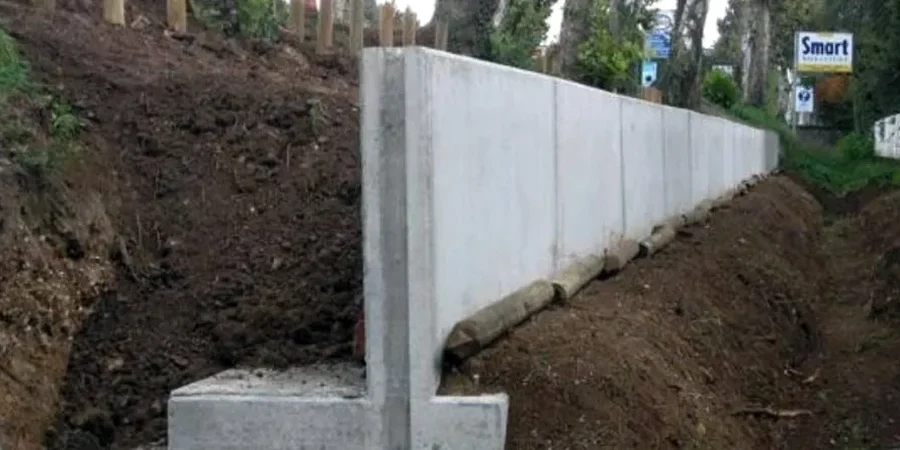
Retaining wall design in Missoula demands rigorous attention to the glacial lacustrine deposits that blanket the valley floor, particularly the silts and clays of Glacial Lake Missoula origin that extend from the Clark Fork River floodplain up to the mountain front. The City of Missoula Building Division enforces the current edition of the IBC, referencing ASCE 7 for minimum design loads and AASHTO for walls adjacent to public rights-of-way. Because these fine-grained soils exhibit low permeability and seasonal groundwater perched on underlying gravel lenses, lateral earth pressures can deviate substantially from textbook at-rest values. Our team analyzes consolidated-undrained shear strength from undisturbed Shelby tube samples to determine whether drained or undrained parameters control the design, an often-overlooked distinction in regions where the water table fluctuates by several feet between April snowmelt and August baseflow. For walls exceeding six feet in height, we integrate site-specific slope stability analysis to verify global stability before finalizing reinforcement geometry.

Glacial Lake Missoula silts can transition from drained to undrained loading in a single wet spring — we design for both scenarios.

How we work

Conditions vary dramatically between the Rattlesnake Valley and the South Hills, and retaining wall design must reflect these contrasts. In the Rattlesnake area, colluvial soils derived from Belt Supergroup metasediments mantle the lower slopes, producing a mix of angular gravel and sandy silt that drains reasonably well but can mask shallow bedrock at depths of 4 to 7 feet. The South Hills, by contrast, sit atop thick sequences of glacially overridden terrace gravels interbedded with hardpan layers that restrict vertical drainage and create hydrostatic pressure behind walls. We characterize these materials through laboratory direct shear testing on reconstituted specimens, measuring effective friction angles that typically range from 32° to 38° for the gravels and 26° to 30° for the finer fractions. When wall foundations bear on the Missoula Valley aquifer gravels, allowable bearing pressures often exceed 4,000 psf, but the presence of compressible silt lenses may require deeper embedment or ground improvement. Where the project involves cuts into natural slopes, we reference the test pits observations to log the actual stratigraphy and confirm whether the design assumptions align with what the backhoe uncovers.
Retaining Wall Design in Missoula: Geotechnical Parameters for Montana Terrain
Technical reference image — Missoula

Local considerations

Missoula's semi-arid summers and heavy spring snowmelt create a hydrogeologic regime that punishes poorly drained retaining walls. From late March through June, the combination of rain-on-snow events and rising groundwater in the alluvial aquifer can generate hydrostatic pressures that exceed the lateral earth pressure by a factor of two or more if weep holes clog or the backfill loses permeability. Winter freeze-thaw cycles penetrate 30 to 42 inches into the backfill, particularly on north-facing walls in the Rattlesnake and Grant Creek corridors, where frost heave of saturated silt can displace wall stems incrementally over several seasons. The Missoula Valley also lies within Seismic Design Category D, meaning that walls supporting structures or located near property lines must be checked for seismic earth pressure increments per ASCE 7 Chapter 11. We specify free-draining backfill gradations consistent with ASTM D2487 requirements for open-graded material and verify compaction through nuclear density testing to ensure that the drainage layer performs as intended over the wall's service life.

Need a geotechnical assessment?

Reply within 24h.

Email: contact@geotechnicalengineering1.org

Typical values

ParameterTypical value
Soil unit weight (saturated)120 – 135 pcf
Effective friction angle (gravelly soils)34° – 40°
Effective friction angle (silty soils)26° – 32°
Undrained shear strength (CH clays)800 – 2,200 psf
At-rest earth pressure coefficient (OCR 2-4)0.45 – 0.65
Groundwater fluctuation range3 – 8 ft
Design reference wind speed (ASCE 7, Risk Cat. II)105 mph

Related services

01

Lateral Earth Pressure Analysis

We calculate at-rest, active, and passive earth pressure coefficients using laboratory-measured effective stress parameters, accounting for backslope inclination, wall batter, and seismic surcharge per ASCE 7.

02

Foundation Bearing Capacity Verification

For walls founded on Missoula Valley glacial deposits, we evaluate both general shear and punching shear failure modes, applying bearing capacity factors corrected for footing embedment and groundwater depth.

03

Global Stability and Sliding Checks

Using limit equilibrium methods that incorporate the stratigraphic contacts between gravel lenses and silt layers, we assess sliding resistance, overturning moments, and deep-seated failure surfaces extending beyond the wall footprint.

Regulatory framework

ASCE 7-22 Minimum Design Loads for Buildings and Other Structures, IBC 2021 (adopted by City of Missoula with local amendments), ASTM D1586 Standard Test Method for Standard Penetration Test (SPT), ASTM D2487 Standard Practice for Classification of Soils, AASHTO LRFD Bridge Design Specifications (walls adjacent to public roads)

Questions and answers

What is the typical cost range for retaining wall design services in Missoula?

Retaining wall design fees in Missoula generally range from US$1,160 to US$4,110 depending on wall height, site access, and the number of borings required. A straightforward segmental block wall under 6 feet with good soil conditions falls at the lower end, while a cantilevered cast-in-place wall over 10 feet with difficult access and groundwater issues moves toward the upper end.

How deep should borings go for a retaining wall in Missoula's glacial soils?

Borings should extend a minimum of 1.5 times the wall height below the proposed footing elevation, or until competent bearing material is confirmed. In the Missoula Valley, we typically target 20 to 30 feet for walls in the 8-to-12-foot range, as the contact between glacial lake silts and underlying gravel can be irregular and must be verified across the wall alignment.

Does Missoula require a geotechnical report for retaining walls under 4 feet?

The City of Missoula generally does not require a geotechnical report for non-structural landscape walls under 4 feet provided they are not supporting a surcharge. However, any wall retaining more than 4 feet of soil or located within a setback from property lines or structures typically triggers plan review that includes a soils report.

How do you handle groundwater behind retaining walls in the Missoula Valley?

We design a continuous drainage system using free-draining backfill (ASTM D2487 GP or GW gradation) with a perforated collector pipe at the base, daylighting to a suitable outlet. For walls where the seasonal groundwater table intersects the backfill zone, we may specify a geocomposite drain or chimney drain to intercept perched water before it reaches the wall face.
Location and service area

We serve projects in Missoula and surrounding areas.

View larger map