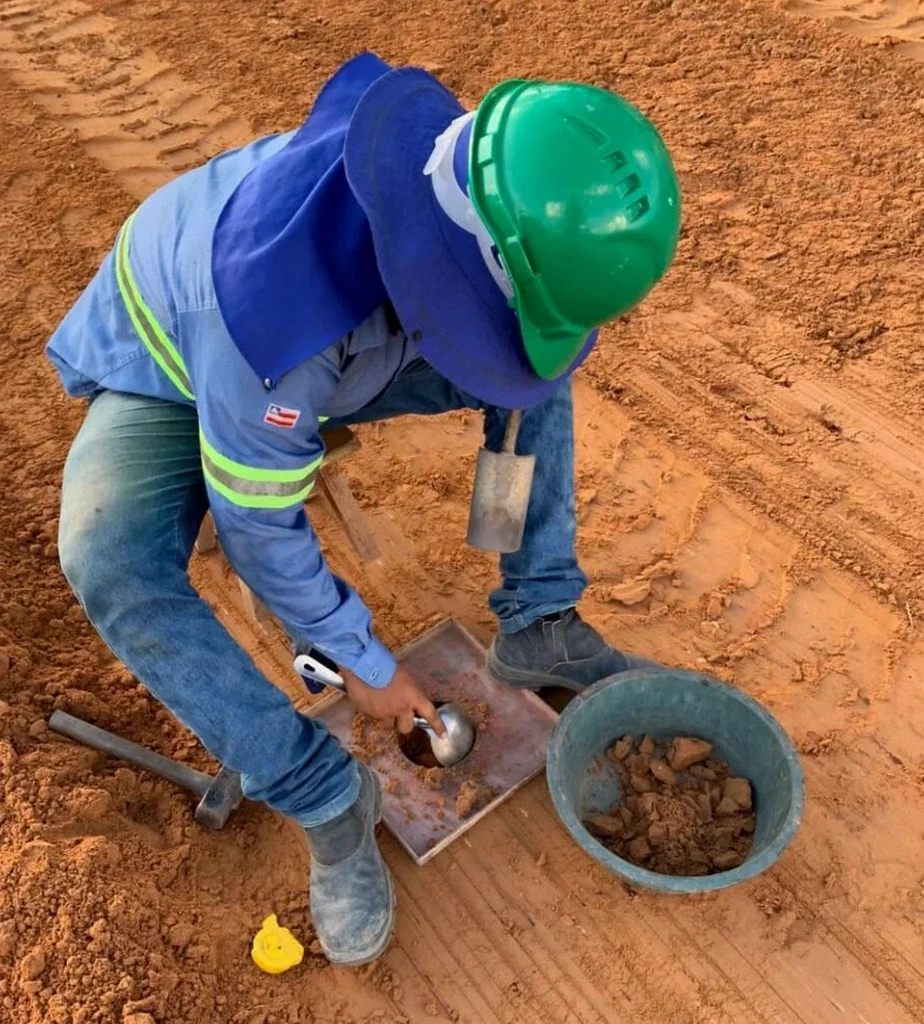
In Missoula, the soil changes fast. One lot is river terrace gravel from the Clark Fork. The next is silty loam left by Glacial Lake Missoula's ancient shoreline. When a contractor calls us after a failed proof roll, it always comes down to one thing: compaction. We run the sand cone test because it gives a direct number. No inferred readings. No density gauge calibration errors. Just a hole, a known volume of Ottawa sand, and a scale. Over years of testing from the Grant Creek area to the Bitterroot Valley, our team has seen how seasonal saturation in Missoula's silts can mislead nuclear gauge readings. That is why we still rely on the sand cone method for final acceptance on engineered fill pads and critical utility backfill. Pairing this with a plate load test helps confirm bearing response, and for deeper exploration we often bring in SPT drilling to log the native material under the compacted lift.
A sand cone test gives you one number that nobody can argue with. It is the in-place density, direct from the field, traceable to a calibrated sand volume.
How we work
The sand cone apparatus is simple. A one-gallon plastic or glass jar attached to a metal cone with a valve. A base plate with a six-inch hole. A bag of calibrated, dry, single-sized silica sand. You dig a precise hole through the compacted lift, weigh every gram of soil removed, then allow the sand to fill the void. Density is mass over volume, plain and simple. In Missoula's well-graded crushed base course, the hole holds its shape well. But in the cohesive silts near the airport, we have to work fast before the walls slump. Our technicians carry multiple sand jars — one calibrated for granular materials, one for finer soils. The cone correction factor changes with aggregate texture, and we recalculate it every day. Missoula's altitude at roughly 3,200 feet does not affect the sand flow, but temperature swings do change sand moisture content if not stored properly. We keep our sand in sealed buckets inside the truck, never in the open bed.
Regional considerations
Missoula sits in Seismic Design Category D per the current IBC maps, with the Bitterroot Fault running along the western edge of the valley. Loose fill that passes a visual inspection but sits below 95% modified Proctor density can settle unevenly during a seismic event. We have seen this in older commercial pads near Reserve Street, where differential settlement cracked slab-on-grade floors within five years. The risk is not just structural. Utility trenches in Missoula's clay-rich soils expand and contract with seasonal moisture cycles — some areas see shrink-swell potential exceeding 4 inches of vertical movement. If trench backfill is not compacted to specification, water lines and sewer laterals shift. A sand cone test on each lift, right over the pipe zone, is cheap insurance against a trench collapse or a broken main. The Missoula Valley's water table sits high in spring; poorly compacted backfill in saturated zones can liquefy under cyclic loading, a phenomenon well documented in the geotechnical literature since Seed and Idriss.
Questions and answers
How much does a sand cone density test cost in Missoula?
A single field density test using the sand cone method typically runs between US$100 and US$150. The exact cost depends on how many tests we perform in one mobilization and the travel distance from our Missoula base. Volume discounts apply for projects with ongoing compaction testing over multiple days.
How many sand cone tests do I need for my project?
Standard practice in Missoula follows IBC and project geotechnical report recommendations. For structural fill, expect one test per 2,500 square feet per lift. Utility trenches usually require a test every 50 linear feet. We review your project specifications and set a testing schedule that keeps your compaction crew moving without delays.
What is the difference between a sand cone test and a nuclear density gauge?
The sand cone measures density directly by volume displacement. A nuclear gauge infers density from radiation backscatter. In Missoula's silty soils, nuclear gauges can read 3-5 pcf off due to moisture and chemistry interference. The sand cone is slower but it is the referee method. When there is a dispute on compaction results, the sand cone is what we use to settle it.
How soon do I get the test results after the field work?
You get a verbal pass/fail as soon as the sand cone calculation is complete — usually within 10 minutes on site. The formal stamped PDF report with test location, depth, density, moisture, and percent compaction arrives by email within one business day.