← Home · Slopes & Walls

Active/Passive Anchor Design for Montana Terrain

Together, we solve the challenges of tomorrow.

LEARN MORE →

The most expensive anchor systems in western Montana aren't the ones with high steel grades; they are the ones installed without verifying the bond zone in Missoula's glacial till. Contractors working near the Clark Fork River occasionally rely on friction assumptions from standard tables, only to discover the till contains pockets of silt that reduce grout-to-ground bond strength by half. Our design approach starts with site-specific parameters rather than textbook values. By correlating SPT drilling data with lab shear strength from the triaxial test, we establish a bond stress profile that reflects actual subsurface conditions beneath the Missoula valley floor. The distinction between active and passive anchors matters here: active systems need a defined unbonded length to transfer load to competent strata, while passive anchors develop resistance through deformation of the bonded zone. Both require a design that accounts for the frost line at 42 inches and the seismic category assigned to Missoula under ASCE 7.

Bond zone verification in glacial till is the difference between an anchor that holds for 50 years and one that creeps toward failure in the first freeze-thaw cycle.

How we work

A practical observation from projects in Missoula: the glacial lake sediments along Reserve Street often contain interbedded clays that creep under sustained load. This affects long-term anchor performance more than peak pullout capacity. We specify locked-off loads that anticipate 60-day relaxation losses of 3 to 7 percent for active tiebacks in these deposits. Our design packages include: load transfer diagrams showing stress distribution along the bonded length; corrosion protection levels based on soil resistivity measured on site; and installation sequencing that prevents group effects when anchors are spaced closer than three feet center-to-center. For cut-and-cover excavations near the Bitterroot River, we often integrate passive anchors with the retaining walls structural design to create a composite system that works within Missoula's right-of-way constraints. Every submittal references IBC Chapter 18 soil parameters and the PTI DC35.1 recommendations for grouted anchors. Proof testing protocols follow the 1.33 times design load requirement with a 10-minute creep observation period, not the shorter duration sometimes accepted in warmer climates.
Active/Passive Anchor Design for Montana Terrain
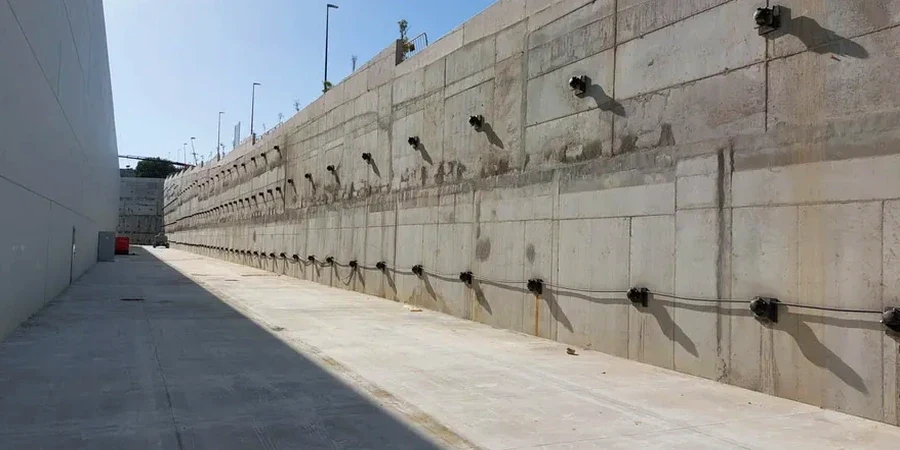
Technical reference image — Missoula

Local considerations

Missoula sits at 3,209 feet elevation in a valley where the frost line reaches three-and-a-half feet, and the 1959 Hebgen Lake earthquake—magnitude 7.2—reminded engineers across western Montana that seismic loads propagate far beyond the epicenter. Anchor systems designed without seismic redundancy risk progressive failure when the bonded zone intersects liquefiable lenses. The bigger operational risk is creep rupture in passive anchors: if the grout column in Missoula's silty till does not achieve full encapsulation, pore water migrates into micro-cracks during spring thaw and initiates corrosion that goes undetected behind a finished wall facing. We mitigate this through double-corrosion protection on permanent anchors and by specifying sacrificial steel thicknesses based on the soil resistivity values measured directly in Missoula borings. A single anchor failure in a tied-back excavation near downtown can shut down a block for weeks, so the design includes accessible stressing heads for periodic lift-off testing on critical structures.

Need a geotechnical assessment?

Reply within 24h.

Email: contact@geotechnicalengineering1.org

Typical values

ParameterTypical value
Design life (permanent anchors)50 years minimum per IBC
Proof test load1.33 × design load, 10-minute hold
Bonded length in till15–30 ft depending on N-value
Unbonded length (active)≥ 15 ft or beyond failure wedge
Lock-off load110% of design load, adjusted for relaxation
Corrosion protectionClass I or II per PTI DC35.1
Anchor spacing minimum3× borehole diameter or 4 ft

Related services

01

Active tieback design for deep excavations

Prestressed anchors with defined unbonded lengths, lock-off loads specified to control wall deflection in urban Missoula projects where adjacent structures limit movement tolerance.

02

Passive anchor and soil nail systems

Grouted bars that develop resistance through ground deformation, suited for slope stabilization along I-90 corridors where access restrictions prevent large drilling equipment.

03

Corrosion protection specification

Class I and II protection details based on soil resistivity and pH testing from Missoula site investigations, including epoxy coating, sheathing, and centralized grouting methods.

04

Anchor load testing and verification

Performance, proof, and extended creep tests following PTI protocols, with data-logged load cells and lift-off checks at 7, 30, and 180 days post-installation.

Regulatory framework

IBC 2024 – Chapter 18 Soils and Foundations, ASCE 7-22 – Minimum Design Loads (seismic provisions), PTI DC35.1-14 – Recommendations for Prestressed Rock and Soil Anchors, ASTM A615 – Deformed and Plain Carbon-Steel Bars, FHWA GEC No.4 – Ground Anchors and Anchored Systems

Questions and answers

What is the cost range for anchor design on a typical Missoula commercial excavation?

For a project with 15 to 30 anchors supporting a retained height under 20 feet, the design and testing package typically falls between US$1,170 and US$3,930 depending on the number of load tests required and whether corrosion protection is Class I or Class II. Complex sites near the Clark Fork with high groundwater add to the scope.

How does the Missoula frost depth affect anchor design?

The 42-inch frost line means the top portion of any anchor must be isolated from freeze-thaw cycles. We specify an unbonded length that extends below the frost penetration zone in active anchors, and for passive systems we require full grout encapsulation below that depth to prevent ice lens formation from jacking the anchor head.

What is the difference between active and passive anchors?

Active anchors are tensioned at installation to a specified lock-off load, creating immediate restraint against movement. Passive anchors, including soil nails, develop their force only when the ground deforms. In Missoula's stiff glacial till, active systems suit excavations where wall deflection must stay under half an inch; passive systems work well for slope stabilization where some movement is acceptable.

How long does anchor design and approval take for a Missoula project?

A typical design package with calculations, corrosion protection details, and testing specifications takes 10 to 14 business days after we receive the geotechnical report and structural loading requirements. City of Missoula building review adds another two to three weeks, depending on project complexity and whether the work falls within the floodplain overlay zone.
Location and service area

We serve projects in Missoula and surrounding areas.

View larger map