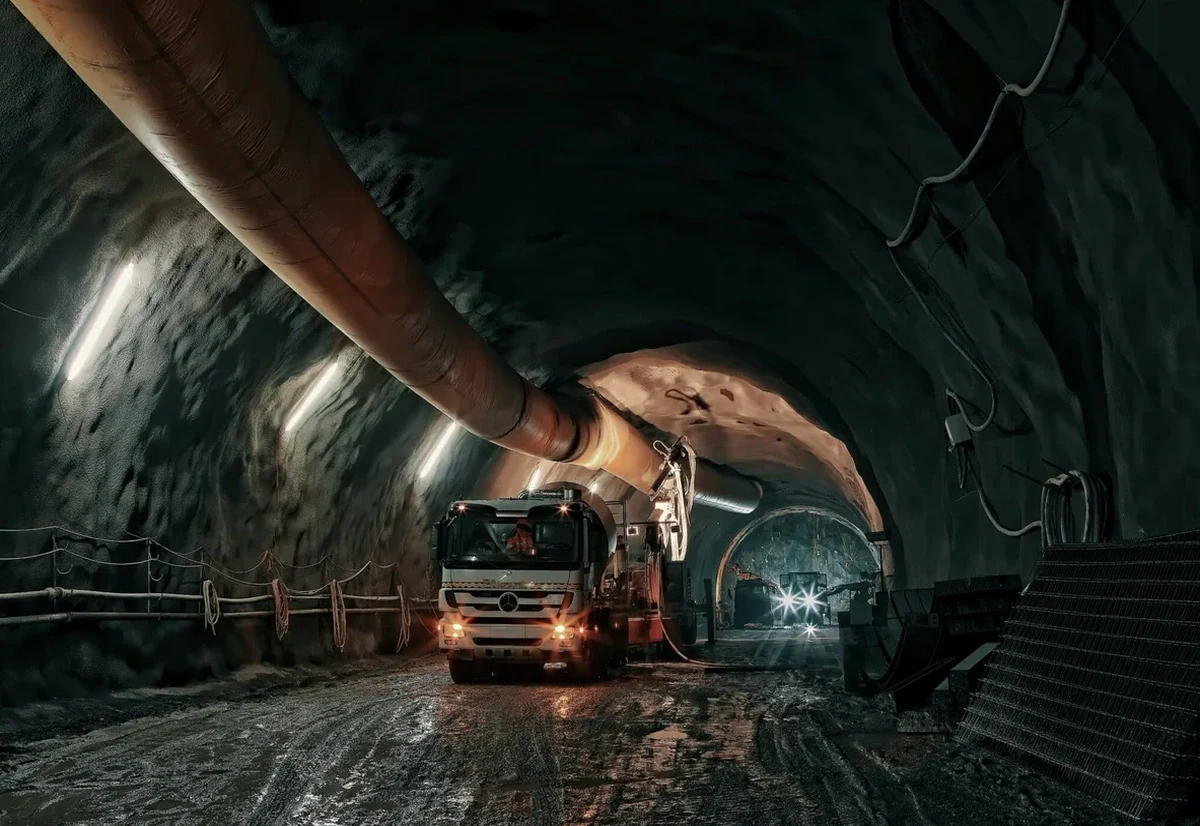
Tunneling through the Missoula Valley floor presents conditions radically different from the bedrock of the Rattlesnake foothills. Down near the Clark Fork River, the subsurface is dominated by fine-grained glacial Lake Missoula sediments—silts and clays that can stand for a short time but deform significantly under sustained load. Uphill, toward the South Hills, you might encounter weathered Belt Supergroup argillite within the first ten feet, which changes the entire face stability calculation. We’ve seen preliminary desktop studies miss these transitions entirely, leading to over-excavation and schedule delays that could have been avoided with targeted borings. Our approach ties every CPT test profile to the specific geomorphic unit being crossed, because a tunnel alignment that spans from the floodplain to the alluvial fan demands more than a single representative cross-section.
In Missoula’s glaciolacustrine deposits, stand-up time is measured in hours, not days—and it varies block by block along the same tunnel drive.
Questions and answers
What makes Missoula’s soft ground different from tunneling clays elsewhere in the Northwest?
The difference comes down to the depositional history. Missoula sits on sediments from Glacial Lake Missoula—rhythmically bedded silts and clays that were not overconsolidated by ice loading the way Seattle’s glacial tills were. This means the local soils exhibit lower in-situ horizontal stress and shorter stand-up time at the face. We also find scattered erratics dropped from icebergs, which create abrupt hard spots during excavation. Our lab runs a full suite of Atterberg limits and one-dimensional consolidation tests to distinguish these lacustrine clays from residual soils derived from Belt rock weathering.
Do you handle groundwater control design for soft ground tunnels in Missoula?
Yes, dewatering and groundwater control are integral to every tunnel analysis we deliver. We install vibrating wire piezometers in dedicated boreholes and monitor them through at least one full hydrological cycle before finalizing the design. In the Missoula Valley, the Clark Fork River aquifer and the shallow unconfined water table respond quickly to snowmelt, so we base dewatering flow rates on April-to-June peak conditions. The report includes recommended well spacing, pump capacity, and drawdown predictions using analytical solutions and, for complex stratigraphy, MODFLOW modeling.
What is the typical cost range for a soft ground tunnel geotechnical investigation in Missoula?
For a comprehensive soft ground tunnel investigation in Missoula—covering deep borings, CPTu soundings, geophysical surveys, laboratory triaxial and consolidation testing, and a full interpretative report with face stability and settlement analyses—the budget typically falls between US$4,730 and US$17,460. The range depends on tunnel length, depth, number of access points, and whether groundwater monitoring over multiple seasons is required. A shorter utility tunnel with two boreholes and basic lab work will be at the lower end; a longer transit tunnel crossing beneath the Clark Fork with continuous CPT and advanced numerical modeling will approach the upper end.