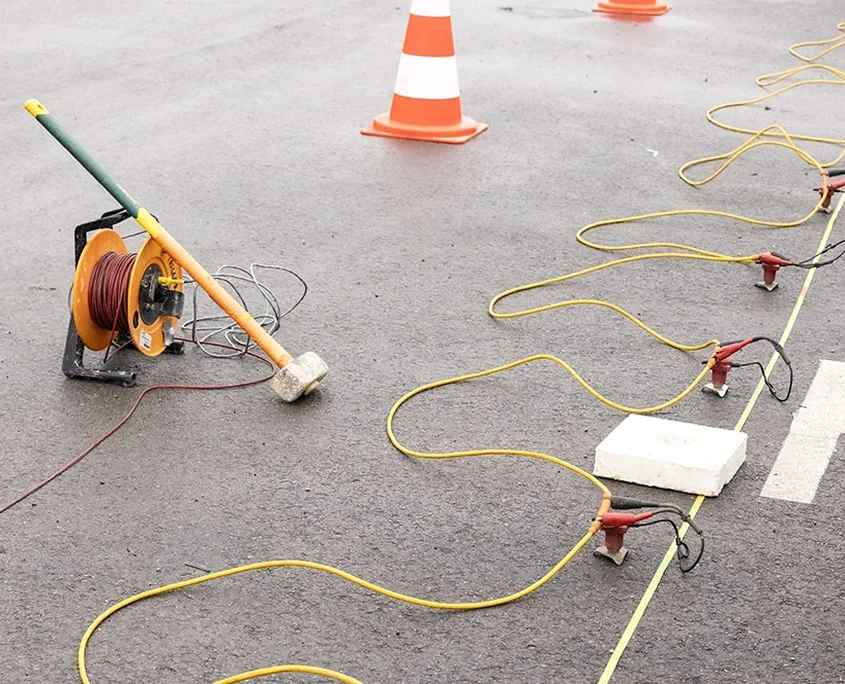
Misinterpreting Missoula’s subsurface as uniform glacial sediment is a costly mistake. The valley floor conceals an irregular bedrock profile—Belt Supergroup metasediments buried under highly variable alluvial and glacial outwash deposits. Boring logs alone cannot resolve lateral velocity contrasts that signal a buried scarp, a deep paleochannel, or a boulder train left by the Missoula floods. Seismic tomography provides the continuous cross-section that isolated borings miss. We run 2D refraction lines and, where resolution demands it, reflection spreads that image strata to 100 meters depth. The data feed directly into rippability assessments for excavation planning and into site-class determination per ASCE 7-22. For projects near the Clark Fork River corridor, we often pair tomography with CPT soundings to calibrate velocity with tip resistance where soft silts overlie dense gravel. The Missoula County building department increasingly requests geophysical cross-sections when foundation design crosses mapped Missoula Group fault traces, and a well-constrained p-wave model satisfies that requirement without excessive trenching.
A 24-channel refraction spread across a Missoula gravel terrace resolves whether the dense cobble layer is 4 feet or 12 feet thick—a difference that changes the entire excavation bid.
Questions and answers
How much does a seismic tomography survey cost for a typical Missoula building site?
A standard single-line refraction survey with Vs30 processing runs between US$2,330 and US$4,680, depending on line length, number of channels, and site access conditions. Steep terrain or dense vegetation that slows geophone layout adds field time and cost. We supply a fixed-price quote after reviewing the site plan and target depth requirements.
Can seismic tomography distinguish between weathered and competent bedrock?
Yes—that is exactly what the velocity gradient resolves. In Missoula, weathered Belt argillite typically shows p-wave velocities from 800 to 1,600 m/s, while competent quartzite exceeds 2,400 m/s. The tomogram displays this transition as a color contour, and the rippability log translates it directly into excavator terms: rippable, marginal, or blasting required.
What is the difference between seismic refraction and reflection for our project?
Refraction maps velocity layers in the upper 15–30 meters and works well for foundation and rippability studies. Reflection images deeper impedance contrasts—useful beyond 30 meters—by recording reflected energy rather than refracted head waves. We recommend refraction for most Missoula building sites and reflection when the target is a deep fault, a bedrock trough, or a tunnel alignment beneath the valley fill.