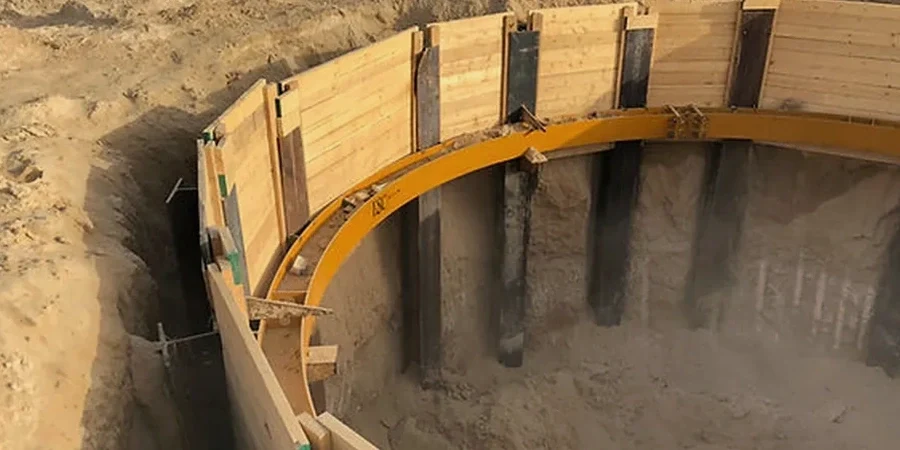
Missoula's growth from a frontier trading post to a bustling mountain hub has pushed construction onto increasingly complex ground. The ancient Lake Missoula outburst floods scoured the valley floor, leaving behind wildly variable deposits of cobbles, silts, and clays. When the Clark Fork River's historic terraces can't support shallow footings, the conversation turns to deep foundations. Our pile foundation design process starts with that geological reality, mapping the interface between loose overburden and the competent bearing strata below. In neighborhoods expanding into the Rattlesnake Valley or commercial projects near the Bitterroot River, we often pair the initial subsurface investigation with CPT testing to get continuous profiles of the soft lacustrine clays before sizing the pile elements.
A pile is only as reliable as the soil spring values you assign to it. In Missoula's layered alluvium, we match each spring to a specific stratigraphic unit, not an average.
Regional considerations
A mixed-use building along Brooks Street started with a geotechnical report that recommended shallow footings based on blow counts from the upper 20 feet. The structural engineer designed for presumed 4,000 psf bearing. During excavation, however, pockets of saturated organic silt appeared beneath the planned footing elevation, material that had been missed between borehole locations. The contractor stopped work, and we were brought in to design a pile foundation system to bridge the compromised zone. The redesign added driven piles socketed into the dense gravel layer at 55 feet, increasing the foundation cost but avoiding a future differential settlement claim that would have dwarfed the upfront expense. That scenario plays out repeatedly across Missoula's variable alluvial fan deposits: the soil you don't test is the soil that drives the failure mode.
Questions and answers
How much does a pile foundation design cost for a Missoula project?
For a standalone pile foundation design package including axial capacity curves, lateral analysis, and the sealed calculation report, project fees typically range from US$1,640 for a straightforward single-pile retrofit to US$7,230 for a full building pile group analysis with multiple load cases and seismic demand. The spread depends on the number of pile elements, the complexity of the soil profile, and whether we are designing for driven piles or drilled shafts.
When are piles required instead of shallow footings in Missoula?
Piles become necessary when the near-surface soils cannot support the design loads without excessive settlement, when the water table is high and the soil is compressible, or when liquefaction or lateral spreading is a concern during a seismic event. In Missoula, we commonly see this transition at sites underlain by more than 15 feet of soft clay or loose silt, particularly in the floodplain zones along the Clark Fork River and its tributaries.
Do you follow the IBC for Missoula pile designs?
Yes, all our pile foundation designs comply with IBC 2021 Chapter 18 and the referenced ASCE 7-22 load provisions. We also follow the FHWA GEC 12 guidelines for driven pile design and construction, and we coordinate with the Missoula County building official on any local amendments that affect deep foundation submittals.
What type of pile works best in Missoula's glacial lake deposits?
The answer depends on the depth to bearing material and the presence of cobbles. In the thick lacustrine clays south of the Clark Fork, drilled shafts with temporary casing work well because they avoid the vibration issues that can remold sensitive silts. Where the gravel is shallower and more uniform, driven H-piles offer faster installation and easier verification via wave equation analysis, but we always weigh the two options against the site-specific subsurface profile before recommending one.
Can you design pile foundations for residential additions in Missoula?
Yes. We routinely design micropile underpinning systems for hillside homes in the Rattlesnake and South Hills areas where shallow bedrock or steep grades make conventional foundations impractical. The process includes a targeted subsurface investigation, calculation of the pile-to-structure connection, and stamped drawings suitable for the Missoula building permit application.